
A Complete Guide
Have you ever bought a pair of glasses that looked perfect in pictures but didn't fit quite right when you tried them on?
Perhaps they were too wide, kept sliding down your nose, or felt uncomfortable around your temples.
The problem might not have been the frame's design. It could simply have been the size.
Just like clothing and shoes, eyeglasses come in different sizes. And understanding your frame measurements can make a significant difference when choosing glasses, especially when shopping online.
At Caramella Signatures, we believe finding the right glasses involves more than choosing a beautiful frame. Your glasses should complement your facial proportions, sit comfortably, and fit securely.
In this guide, we'll explain how to measure your eyeglasses frame size, understand the numbers printed on your glasses, and use those measurements to find a better fit.
1. Understanding Eyeglasses Frame Measurements
Most eyeglasses have three important measurements printed on the inside of one of their temples (the arms of the glasses).
You might see something like:
52 □ 18 145
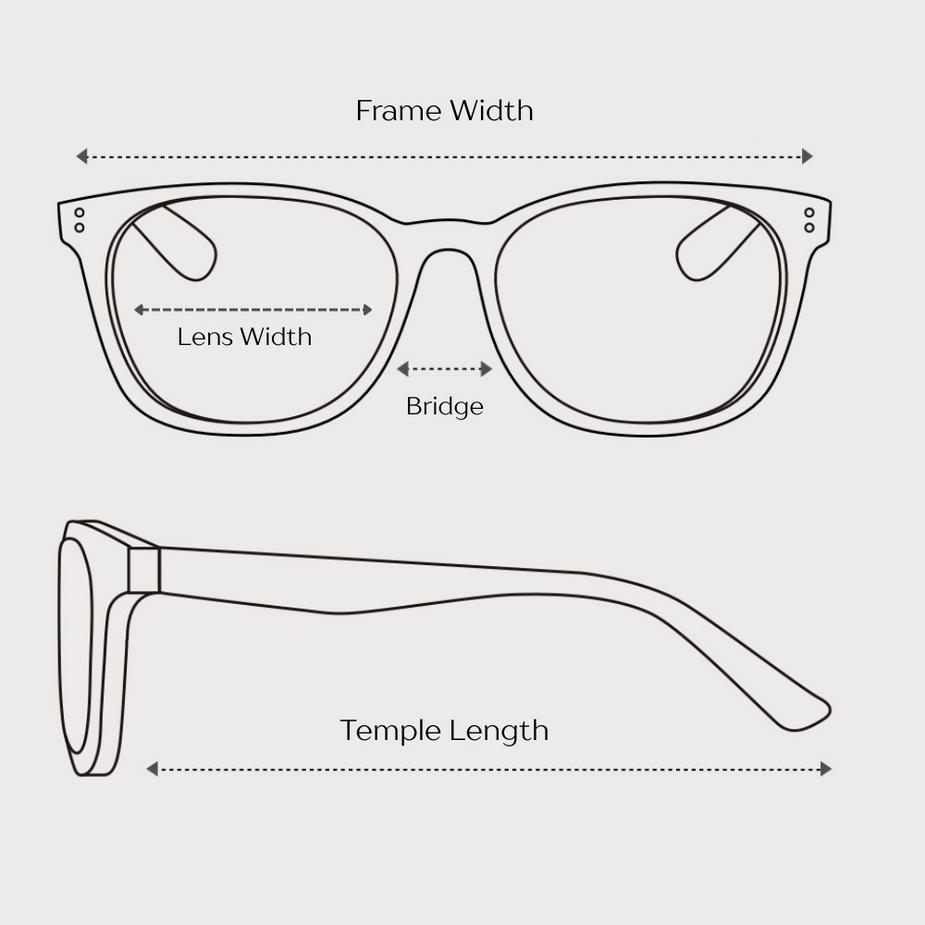
These numbers are measured in millimetres (mm), and each represents a different part of the frame.
52 mm — Lens Width: The horizontal width of one lens opening.
18 mm — Bridge Width: The specified distance between the two lens openings at the bridge.
145 mm — Temple Length: The length of the temple arm, measured according to the manufacturer's sizing convention.
These three measurements are a useful starting point when determining your eyeglasses size.
However, they don't tell you everything about how a frame will fit.
Let's break them down.
2. How to Measure the Lens Width
Lens width is one of the most important measurements when choosing eyeglasses.
It refers to the horizontal distance across one lens opening at its widest point.
How to measure it:
Place your glasses on a flat surface.
Take a millimetre ruler.
Measure the widest horizontal distance across one lens opening, from the inner edge of the opening to the outer edge.
Record the measurement in millimetres.
For example, if the lens opening measures 54 mm across, your lens width is approximately 54 mm.
Why does lens width matter?
Lens width contributes to the overall width of your glasses and influences how the frame looks on your face.
However, a larger lens width does not automatically mean a frame will fit a wider face.
The frame's bridge, end pieces, shape and overall construction also affect its fit.
This is why two pairs of glasses with identical lens widths can feel and look very different.
3. How to Measure the Bridge Width
The bridge is the part of your eyeglasses that connects the two lens rims and sits over your nose.
Bridge width is typically the second number printed on your frame.
For example, in 52 □ 18 145, the bridge width is 18 mm.
How to measure it:
Hold your glasses facing forward.
Identify the inner edges of the two lens openings.
Measure the shortest distance between the lens openings in millimetres.
Record the result.
Why does bridge fit matter?
Your bridge helps determine how your glasses sit on your nose.
A poorly fitting bridge may contribute to:
Glasses sliding down your nose.
Uncomfortable pressure around your nose.
Frames sitting too high or too low.
Glasses resting against your cheeks.
An unstable fit.
Important: The printed bridge measurement does not tell you the full story about nose fit.
Two acetate frames with the same 18 mm bridge measurement can sit differently because their bridge shapes, nose-contact surfaces and overall designs differ.
For example, a saddle bridge and a keyhole bridge can distribute contact differently, even when their printed measurements are identical.
When choosing acetate glasses, pay attention to the actual bridge design, not just the number.
4. How to Measure the Temple Length
The temples are the arms extending from the front of your glasses towards and behind your ears.
Temple length is usually the third number printed inside your glasses.
For example, 52 □ 18 145 indicates a nominal temple length of 145 mm.
How to measure it:
Open one temple arm.
Measure from the hinge area along the temple to its end, following its shape.
If the temple curves, use a flexible measuring tape or a piece of string and then measure the string with a ruler.
Record the measurement.
Your home measurement may differ slightly from the manufacturer's marked length because measurement conventions can vary.
Why does temple length matter?
Temple length affects how the arms extend towards and behind your ears.
Temples that are too short or poorly shaped may cause discomfort, while temples that are too long or incorrectly adjusted may affect how securely your glasses sit.
However, temple length alone doesn't determine comfort.
The angle of the temples, the shape of the arms, the frame's width and professional adjustments also matter.
5. How to Measure the Total Frame Width
Here's something many people overlook when shopping for glasses online.
Lens width is not the same as total frame width.
Total frame width refers to the horizontal measurement across the complete front of your glasses, from the outermost edge on one side to the outermost edge on the other.
It is particularly useful when comparing the fit of different frames.
How to measure it:
Place your glasses on a flat surface with the front facing upward.
Position a ruler horizontally across the frame front.
Measure from the outermost left edge to the outermost right edge.
Record the measurement in millimetres.
For example, your frame might have:
Lens width: 54 mm
Bridge width: 18 mm
Temple length: 145 mm
Total frame width: 142 mm
These are example measurements, not a universal size combination.
Why is total frame width important?
Because two frames with the same lens and bridge measurements may have different total widths due to differences in their rims, hinges and end pieces.
If you have a pair of glasses that fits comfortably, measuring its total width gives you a useful reference when shopping for another pair.
For shoppers looking for glasses for broad faces or narrow faces, total frame width can be especially helpful.
6. How to Measure the Lens Height
Lens height is the vertical measurement of the lens opening at its tallest point.
Unlike lens width, bridge width and temple length, lens height is not always printed on the frame.
How to measure it:
Position your glasses facing forward.
Measure the maximum vertical distance across one lens opening.
Record the measurement in millimetres.
Lens height can influence the appearance of your glasses, how much of your face the frame covers, and whether the frame is suitable for certain prescription lens designs.
For example, progressive lenses require sufficient usable vertical space for their different viewing zones.
However, suitability for progressive lenses cannot be determined from lens height alone. It also depends on the lens design, your prescription and individual fitting measurements.
7. How to Find Your Glasses Size Using Your Current Pair
If you already own a pair of glasses that fits comfortably, you have an excellent starting point.
Instead of guessing your next frame size, use your current glasses as a reference.
Step 1: Check the inside of the temples.
Look for the three printed measurements.
For example: 54 □ 17 145
Step 2: Measure the total frame width.
This helps you understand the actual width of your current glasses.
Step 3: Assess the fit.
Ask yourself:
Do my glasses stay comfortably in place?
Do they slide down my nose?
Do the sides feel tight against my head?
Do the temples sit comfortably around my ears?
Does the frame touch my cheeks when I smile?
Do my eyes sit in an appropriate position within the lenses?
Step 4: Compare with your next frame.
If your current glasses fit well, look for frames with similar measurements and comparable construction.
But remember, matching numbers do not guarantee identical fit.
Frame shape, bridge construction and temple design can all affect how the glasses sit.
8. What Size Glasses Do I Need for My Face?
There is no single eyeglasses size that works for everyone with a particular face shape.
Two people with round faces, for example, may have completely different facial widths, nose bridges, temple positions and fitting requirements.
This is why choosing glasses based on face shape alone can be misleading.
At Caramella Signatures, we encourage customers to consider their facial proportions and the actual dimensions of the glasses.
If you have a broad or wide face
Look for frames with sufficient overall width and comfortable temple positioning.
A frame that is too narrow may create pressure around the sides of your head or appear disproportionately small.
Explore our Wide-Fit Glasses Collection for frame options designed with broader proportions in mind.
If you have a slim or narrow face
Pay particular attention to total frame width.
An excessively wide frame may extend too far beyond your facial proportions or feel unstable.
Explore our Narrow-Fit Glasses Collection for more compact frame options.
If you have a low or less prominent nose bridge
Pay attention to the design of the bridge and how the frame makes contact with your nose.
Some acetate bridge designs may offer better support than others, depending on your individual nasal anatomy.
The correct fit is determined by how the frame actually sits, not simply by selecting a smaller printed bridge number.
9. Can You Measure Your Face to Find Your Glasses Size?
You can use a ruler to estimate your facial width, but this should be treated as a rough guide rather than an exact formula for determining frame size.
Facial width alone does not account for your nose bridge, eye position, temple contact points or the construction of the frame.
For a more reliable starting point, compare the measurements of a comfortable existing pair of glasses with those of the frames you're considering.
If you're buying your first pair, a professional fitting or personalised guidance can help you narrow down suitable options.
10. Common Mistakes to Avoid When Choosing Your Eyeglasses Size
Mistake 1: Choosing glasses based on lens width alone.
A 55 mm lens width does not automatically mean the frame is suitable for a wide face.
Mistake 2: Assuming identical measurements mean identical fit.
Two frames marked 52 □ 18 145 may fit differently because of their bridge shapes, overall widths and temple construction.
Mistake 3: Ignoring your nose bridge.
A beautiful frame can still be uncomfortable if its bridge doesn't provide suitable support.
Mistake 4: Choosing an oversized frame without checking its dimensions.
Oversized glasses can be stylish, but the frame still needs to sit securely and comfortably.
Mistake 5: Assuming every fitting problem requires a different frame size.
Some issues can be improved through professional adjustments, particularly temple positioning. However, significant bridge or frame-width mismatches may require a different design.
11. How to Choose the Right Acetate Glasses at Caramella Signatures
Acetate eyeglasses are available in a wide range of shapes, colours and dimensions, making it possible to explore different looks while considering fit.
When shopping for acetate frames at Caramella Signatures, we recommend checking the available product measurements and comparing them with your existing glasses.
Consider the following:
Your preferred total frame width.
Your current lens and bridge measurements.
The bridge design and how it suits your nose.
Your temple length and comfort preferences.
Whether the frame will accommodate your prescription requirements.
The overall look you want your glasses to create.
And if you're uncertain about the best fit, our team can help you assess your options.
We believe that glasses should do more than look beautiful in a product photograph.
They should feel comfortable, suit your proportions and help you express your personal style.
Frequently Asked Questions About Eyeglasses Frame Sizes
What do the numbers 52-18-145 mean on glasses?
They represent the lens width (52 mm), bridge width (18 mm) and temple length (145 mm). These are the three most common measurements printed on eyeglasses.
How do I know if my glasses are too wide?
Signs may include excessive space at the sides, poor stability or frames that slide out of position. However, sliding can also result from poor bridge fit or temple adjustment, so width is not always the cause.
Can I measure my glasses at home?
Yes. You can use a millimetre ruler to measure lens width, bridge width, lens height and total frame width. A flexible measuring tape can help estimate temple length.
Is 54 mm a large eyeglasses frame?
Not necessarily. A 54 mm lens width may be relatively large for some frame designs, but it does not determine the overall size. Total frame width, shape and bridge dimensions must also be considered.
How do I know my glasses size when buying online?
Start with the measurements of a pair you already own and find comfortable. Compare those measurements with the product specifications, paying particular attention to total frame width and bridge design.
Are eyeglasses sizes the same across brands?
Not always. While many manufacturers use the same basic measurement system, frames with similar marked dimensions can fit differently because of their construction.
Can acetate glasses be adjusted if they don't fit?
Some acetate frames can be adjusted by trained optical professionals using appropriate tools and controlled heat. However, not every fitting problem can be corrected through adjustment.
Find Your Next Pair of Glasses at Caramella Signatures
Now that you understand how to measure your eyeglasses frame size, finding your next pair can be a more informed experience.
Whether you prefer classic rectangles, elegant cat-eye frames, bold geometric designs or sophisticated oversized glasses, understanding your measurements can help you narrow down your options.
At Caramella Signatures, we offer a curated selection of premium acetate eyewear in different shapes, colours and sizes.
Explore our eyewear collections at www.caramellasignatures.com or contact our team for personalised frame-selection guidance.
Because finding the right glasses isn't just about how they look. It's also about how they fit.
A Complete Guide
A Complete Guide
Have you ever bought a pair of glasses that looked perfect in pictures but didn't fit quite right when you tried them on?
Perhaps they were too wide, kept sliding down your nose, or felt uncomfortable around your temples.
The problem might not have been the frame's design. It could simply have been the size.
Just like clothing and shoes, eyeglasses come in different sizes. And understanding your frame measurements can make a significant difference when choosing glasses, especially when shopping online.
At Caramella Signatures, we believe finding the right glasses involves more than choosing a beautiful frame. Your glasses should complement your facial proportions, sit comfortably, and fit securely.
In this guide, we'll explain how to measure your eyeglasses frame size, understand the numbers printed on your glasses, and use those measurements to find a better fit.
1. Understanding Eyeglasses Frame Measurements
Most eyeglasses have three important measurements printed on the inside of one of their temples (the arms of the glasses).
You might see something like:
52 □ 18 145
These numbers are measured in millimetres (mm), and each represents a different part of the frame.
52 mm — Lens Width: The horizontal width of one lens opening.
18 mm — Bridge Width: The specified distance between the two lens openings at the bridge.
145 mm — Temple Length: The length of the temple arm, measured according to the manufacturer's sizing convention.
These three measurements are a useful starting point when determining your eyeglasses size.
However, they don't tell you everything about how a frame will fit.
Let's break them down.
2. How to Measure the Lens Width
Lens width is one of the most important measurements when choosing eyeglasses.
It refers to the horizontal distance across one lens opening at its widest point.
How to measure it:
Place your glasses on a flat surface.
Take a millimetre ruler.
Measure the widest horizontal distance across one lens opening, from the inner edge of the opening to the outer edge.
Record the measurement in millimetres.
For example, if the lens opening measures 54 mm across, your lens width is approximately 54 mm.
Why does lens width matter?
Lens width contributes to the overall width of your glasses and influences how the frame looks on your face.
However, a larger lens width does not automatically mean a frame will fit a wider face.
The frame's bridge, end pieces, shape and overall construction also affect its fit.
This is why two pairs of glasses with identical lens widths can feel and look very different.
3. How to Measure the Bridge Width
The bridge is the part of your eyeglasses that connects the two lens rims and sits over your nose.
Bridge width is typically the second number printed on your frame.
For example, in 52 □ 18 145, the bridge width is 18 mm.
How to measure it:
Hold your glasses facing forward.
Identify the inner edges of the two lens openings.
Measure the shortest distance between the lens openings in millimetres.
Record the result.
Why does bridge fit matter?
Your bridge helps determine how your glasses sit on your nose.
A poorly fitting bridge may contribute to:
Glasses sliding down your nose.
Uncomfortable pressure around your nose.
Frames sitting too high or too low.
Glasses resting against your cheeks.
An unstable fit.
Important: The printed bridge measurement does not tell you the full story about nose fit.
Two acetate frames with the same 18 mm bridge measurement can sit differently because their bridge shapes, nose-contact surfaces and overall designs differ.
For example, a saddle bridge and a keyhole bridge can distribute contact differently, even when their printed measurements are identical.
When choosing acetate glasses, pay attention to the actual bridge design, not just the number.
4. How to Measure the Temple Length
The temples are the arms extending from the front of your glasses towards and behind your ears.
Temple length is usually the third number printed inside your glasses.
For example, 52 □ 18 145 indicates a nominal temple length of 145 mm.
How to measure it:
Open one temple arm.
Measure from the hinge area along the temple to its end, following its shape.
If the temple curves, use a flexible measuring tape or a piece of string and then measure the string with a ruler.
Record the measurement.
Your home measurement may differ slightly from the manufacturer's marked length because measurement conventions can vary.
Why does temple length matter?
Temple length affects how the arms extend towards and behind your ears.
Temples that are too short or poorly shaped may cause discomfort, while temples that are too long or incorrectly adjusted may affect how securely your glasses sit.
However, temple length alone doesn't determine comfort.
The angle of the temples, the shape of the arms, the frame's width and professional adjustments also matter.
5. How to Measure the Total Frame Width
Here's something many people overlook when shopping for glasses online.
Lens width is not the same as total frame width.
Total frame width refers to the horizontal measurement across the complete front of your glasses, from the outermost edge on one side to the outermost edge on the other.
It is particularly useful when comparing the fit of different frames.
How to measure it:
Place your glasses on a flat surface with the front facing upward.
Position a ruler horizontally across the frame front.
Measure from the outermost left edge to the outermost right edge.
Record the measurement in millimetres.
For example, your frame might have:
Lens width: 54 mm
Bridge width: 18 mm
Temple length: 145 mm
Total frame width: 142 mm
These are example measurements, not a universal size combination.
Why is total frame width important?
Because two frames with the same lens and bridge measurements may have different total widths due to differences in their rims, hinges and end pieces.
If you have a pair of glasses that fits comfortably, measuring its total width gives you a useful reference when shopping for another pair.
For shoppers looking for glasses for broad faces or narrow faces, total frame width can be especially helpful.
6. How to Measure the Lens Height
Lens height is the vertical measurement of the lens opening at its tallest point.
Unlike lens width, bridge width and temple length, lens height is not always printed on the frame.
How to measure it:
Position your glasses facing forward.
Measure the maximum vertical distance across one lens opening.
Record the measurement in millimetres.
Lens height can influence the appearance of your glasses, how much of your face the frame covers, and whether the frame is suitable for certain prescription lens designs.
For example, progressive lenses require sufficient usable vertical space for their different viewing zones.
However, suitability for progressive lenses cannot be determined from lens height alone. It also depends on the lens design, your prescription and individual fitting measurements.
7. How to Find Your Glasses Size Using Your Current Pair
If you already own a pair of glasses that fits comfortably, you have an excellent starting point.
Instead of guessing your next frame size, use your current glasses as a reference.
Step 1: Check the inside of the temples.
Look for the three printed measurements.
For example: 54 □ 17 145
Step 2: Measure the total frame width.
This helps you understand the actual width of your current glasses.
Step 3: Assess the fit.
Ask yourself:
Do my glasses stay comfortably in place?
Do they slide down my nose?
Do the sides feel tight against my head?
Do the temples sit comfortably around my ears?
Does the frame touch my cheeks when I smile?
Do my eyes sit in an appropriate position within the lenses?
Step 4: Compare with your next frame.
If your current glasses fit well, look for frames with similar measurements and comparable construction.
But remember, matching numbers do not guarantee identical fit.
Frame shape, bridge construction and temple design can all affect how the glasses sit.
8. What Size Glasses Do I Need for My Face?
There is no single eyeglasses size that works for everyone with a particular face shape.
Two people with round faces, for example, may have completely different facial widths, nose bridges, temple positions and fitting requirements.
This is why choosing glasses based on face shape alone can be misleading.
At Caramella Signatures, we encourage customers to consider their facial proportions and the actual dimensions of the glasses.
If you have a broad or wide face
Look for frames with sufficient overall width and comfortable temple positioning.
A frame that is too narrow may create pressure around the sides of your head or appear disproportionately small.
Explore our Wide-Fit Glasses Collection for frame options designed with broader proportions in mind.
If you have a slim or narrow face
Pay particular attention to total frame width.
An excessively wide frame may extend too far beyond your facial proportions or feel unstable.
Explore our Narrow-Fit Glasses Collection for more compact frame options.
If you have a low or less prominent nose bridge
Pay attention to the design of the bridge and how the frame makes contact with your nose.
Some acetate bridge designs may offer better support than others, depending on your individual nasal anatomy.
The correct fit is determined by how the frame actually sits, not simply by selecting a smaller printed bridge number.
9. Can You Measure Your Face to Find Your Glasses Size?
You can use a ruler to estimate your facial width, but this should be treated as a rough guide rather than an exact formula for determining frame size.
Facial width alone does not account for your nose bridge, eye position, temple contact points or the construction of the frame.
For a more reliable starting point, compare the measurements of a comfortable existing pair of glasses with those of the frames you're considering.
If you're buying your first pair, a professional fitting or personalised guidance can help you narrow down suitable options.
10. Common Mistakes to Avoid When Choosing Your Eyeglasses Size
Mistake 1: Choosing glasses based on lens width alone.
A 55 mm lens width does not automatically mean the frame is suitable for a wide face.
Mistake 2: Assuming identical measurements mean identical fit.
Two frames marked 52 □ 18 145 may fit differently because of their bridge shapes, overall widths and temple construction.
Mistake 3: Ignoring your nose bridge.
A beautiful frame can still be uncomfortable if its bridge doesn't provide suitable support.
Mistake 4: Choosing an oversized frame without checking its dimensions.
Oversized glasses can be stylish, but the frame still needs to sit securely and comfortably.
Mistake 5: Assuming every fitting problem requires a different frame size.
Some issues can be improved through professional adjustments, particularly temple positioning. However, significant bridge or frame-width mismatches may require a different design.
11. How to Choose the Right Acetate Glasses at Caramella Signatures
Acetate eyeglasses are available in a wide range of shapes, colours and dimensions, making it possible to explore different looks while considering fit.
When shopping for acetate frames at Caramella Signatures, we recommend checking the available product measurements and comparing them with your existing glasses.
Consider the following:
Your preferred total frame width.
Your current lens and bridge measurements.
The bridge design and how it suits your nose.
Your temple length and comfort preferences.
Whether the frame will accommodate your prescription requirements.
The overall look you want your glasses to create.
And if you're uncertain about the best fit, our team can help you assess your options.
We believe that glasses should do more than look beautiful in a product photograph.
They should feel comfortable, suit your proportions and help you express your personal style.
Frequently Asked Questions About Eyeglasses Frame Sizes
What do the numbers 52 18 145 mean on glasses?
They represent the lens width (52 mm), bridge width (18 mm) and temple length (145 mm). These are the three most common measurements printed on eyeglasses.
How do I know if my glasses are too wide?
Signs may include excessive space at the sides, poor stability or frames that slide out of position. However, sliding can also result from poor bridge fit or temple adjustment, so width is not always the cause.
Can I measure my glasses at home?
Yes. You can use a millimetre ruler to measure lens width, bridge width, lens height and total frame width. A flexible measuring tape can help estimate temple length.
Is 54 mm a large eyeglasses frame?
Not necessarily. A 54 mm lens width may be relatively large for some frame designs, but it does not determine the overall size. Total frame width, shape and bridge dimensions must also be considered.
How do I know my glasses size when buying online?
Start with the measurements of a pair you already own and find comfortable. Compare those measurements with the product specifications, paying particular attention to total frame width and bridge design.
Are eyeglasses sizes the same across brands?
Not always. While many manufacturers use the same basic measurement system, frames with similar marked dimensions can fit differently because of their construction.
Can acetate glasses be adjusted if they don't fit?
Some acetate frames can be adjusted by trained optical professionals using appropriate tools and controlled heat. However, not every fitting problem can be corrected through adjustment.
Find Your Next Pair of Glasses at Caramella Signatures
Now that you understand how to measure your eyeglasses frame size, finding your next pair can be a more informed experience.
Whether you prefer classic rectangles, elegant cat-eye frames, bold geometric designs or sophisticated oversized glasses, understanding your measurements can help you narrow down your options.
At Caramella Signatures, we offer a curated selection of premium acetate eyewear in different shapes, colours and sizes.
Explore our eyewear collections at www.caramellasignatures.com or contact our team for personalised frame-selection guidance.
Because finding the right glasses isn't just about how they look. It's also about how they fit.